LED Is Not Laser: An Early Trial of Low-Power Red Light for Myopia
Jagrut Lallu — BOptom (Hons), MSc Specialty Lenses (Hons), FIAOMC. Therapeutic Optometrist & Contact Lens Specialist. Founder, New Zealand Eye Research Centre; Partner, Rose Optometry; WCO Asia-Pacific Myopia Ambassador; International Myopia Institute NZ Ambassador; Clinical Senior Lecturer, Deakin School of Optometry; Honorary Teaching Fellow, University of Auckland.
Red-light therapy for myopia has generated strong results and real safety concerns in roughly equal measure. Most of that evidence comes from laser-based devices, known as repeated low-level red-light therapy (RLRL). A new trial by Duan and colleagues in Ophthalmology and Therapy tests something different: a lower-power, non-coherent LED device. I have read the full text. The key message is that LED and laser are not interchangeable, and this study offers a preliminary signal, not proof.
Why the light source matters
Laser light is coherent and can concentrate energy on a small retinal area. The authors cite laboratory work suggesting some laser devices may reach safety limits within less than the recommended 180-second session, along with clinical reports of reduced cone density and reversible retinal changes after laser red-light exposure. LED light is non-coherent and more diffuse, which may carry a safety advantage but may also deliver a weaker effect. I have covered the laser evidence and its caveats in our review of red-light therapy for myopia, so I will not repeat it here.
How the trial was run
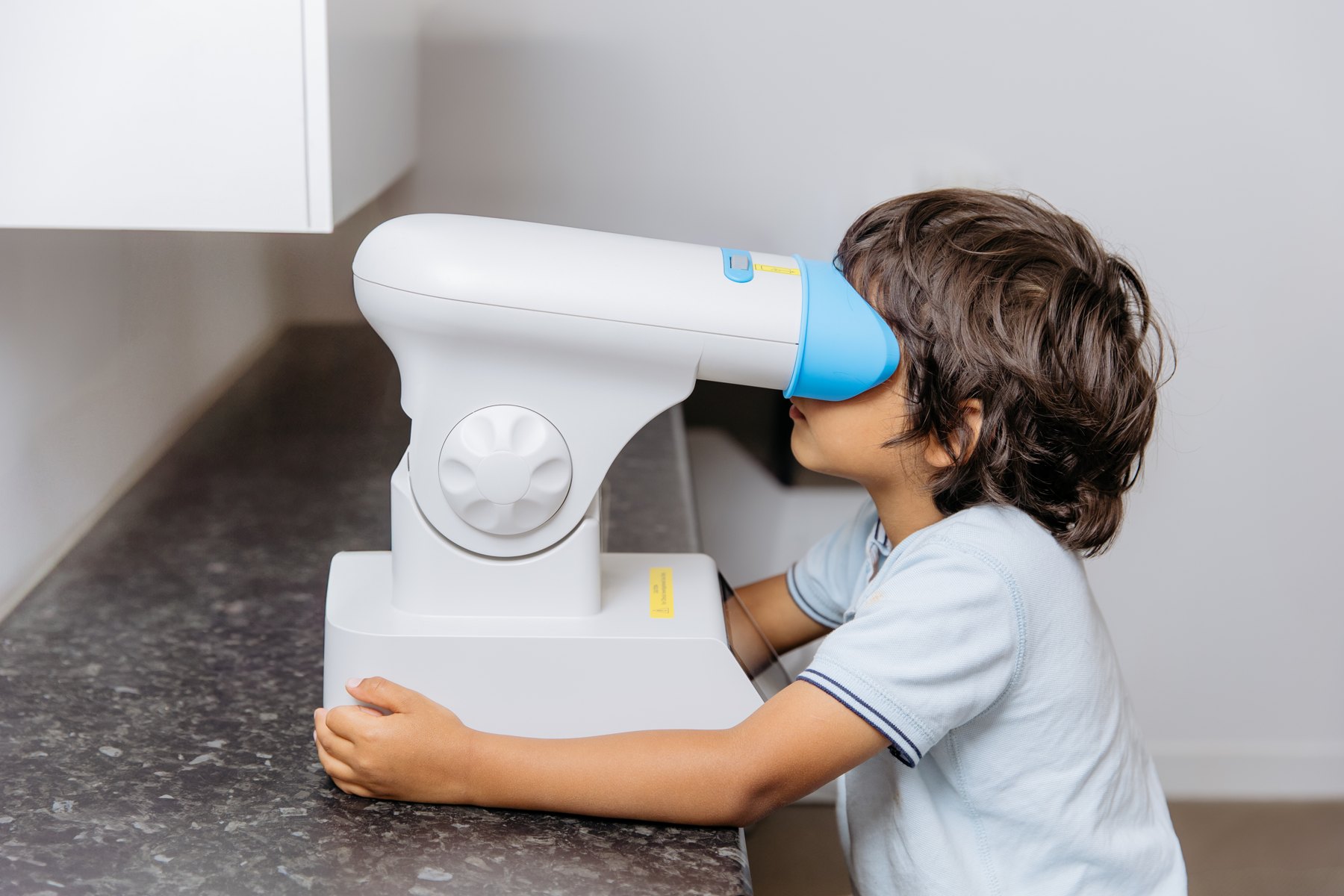
This was a single-centre, sham-controlled pilot in Shanghai. Forty children aged 8 to 12 with cycloplegic refraction between −0.50 and −6.00 D were randomised, 20 to the active device and 20 to an identical-looking sham. The active device (AI-PBM01, made by Beijing Airdoc Technology) emits 650 nm red light at 1.6 mW, in a ring-shaped pattern designed to avoid the centre of the macula. The sham emitted 0.001 mW. Children used it at home for 3 minutes, twice a day, at least 4 hours apart, for 3 months. All 40 completed follow-up.
There was no formal sample-size calculation, and nobody checked whether children or parents could tell active from sham. With a visible red light at full power versus near-zero output, that question matters.
What the trial found
The primary outcome was change in axial length over 3 months. The researchers first analysed right and left eyes separately. In the left eye, the LED group grew 0.056 mm less than sham (95% CI, −0.109 to −0.004; P = 0.036). In the right eye, the difference was not statistically significant (P = 0.122).
A difference in one eye but not the other is a warning sign, not a finding. The more appropriate analysis averages both eyes for each child, and this was added at the request of peer reviewers. On that basis, the difference in axial growth at 3 months was −0.059 mm (95% CI, −0.121 to 0.003; P = 0.061). For refraction it was 0.244 D (95% CI, −0.041 to 0.529; P = 0.092). After adjusting for baseline values, age and sex, none of these differences was statistically significant.
Here is how to read those numbers. A 95% confidence interval is the range of true effects compatible with the data. When it crosses zero, as both participant-level intervals do, the data are consistent with no effect at all. The P-value estimates how surprising the result would be if the device did nothing. Values of 0.061 and 0.092 are not small enough to rule out chance, particularly in a 40-child study with many separate comparisons.
The authors also caution against multiplying a 3-month difference by four to estimate a yearly effect. For context, they cite a meta-analysis of laser RLRL with a pooled 3-month axial difference of −0.21 mm, which is larger than what was seen here.
Choroid and safety
Choroidal thickness at the centre of the left eye showed a nominal difference of 11.55 µm (P = 0.045). After correcting for nine separate retinal zones, it was not significant (adjusted P = 0.402). Our post on choroidal thickness measurement explains why single-zone changes like this need caution.
No serious adverse events or structural retinal abnormalities on OCT were found. However, uncorrected vision fell by at least two lines in 4 of 40 eyes in the LED group (1 right, 3 left) and 1 of 40 in the sham group. One LED-treated eye dropped four lines at 1 month and was still two lines worse at 3 months. No eye lost two lines of best-corrected vision, but two of the affected eyes lost one line. Glare or halo during use was reported by 4 of 20 LED children and 1 of 20 sham children. Vision was not recorded beyond 3 months, so recovery cannot be confirmed.
Funding
The study was supported by a National Natural Science Foundation of China grant. Airdoc, the device maker, provided the devices, paid the labour costs of the coordinators and technicians who collected on-site data, and partly paid the publication fee. The paper states Airdoc had no role in design, analysis or writing, and the funding statement was corrected after first publication. Given that masking was not verified, industry payment for data-collection staff is worth noting. Our post on conflicts of interest in myopia trials explains why.
Limitations of this evidence
- Small (40 children), single-centre and only 3 months long.
- Exploratory, with no power calculation and many uncorrected comparisons.
- Masking success was not assessed.
- Only one dose setting was tested; durability, rebound and long-term retinal safety are unknown.
- The manufacturer supported the study financially and with devices.
What this means in practice
This trial does not show that LED red light controls myopia, and it should not be read as a safer substitute for laser RLRL with the same effect. It shows an early, uncertain signal worth testing in larger, longer trials with careful vision and retinal monitoring. For now, options with stronger evidence remain the starting point for most children. For one head-to-head comparison of two established options, see our review of the DIMS lenses versus 0.01% atropine trial.
About the New Zealand Eye Research Centre
The New Zealand Eye Research Centre is an independent clinical research centre at 37 Lake Road, Frankton, Hamilton 3204. It conducts and reviews eye research with a team trained in Good Clinical Practice (GCP). Enquiries can be sent to research@nzerc.com. Clinicians can read how to refer a patient to eye research, and families can read what taking part in eye research involves.
Clinical care
Myopia management in Hamilton is provided at Rose Optometry, 38 Lake Road, by optometrists Jagrut Lallu, Jacqueline Rowe, Emilie Lawson, Jason Shen and Stella Wong. The author is a partner in the practice. Information on myopia control at Rose Optometry is on the practice website, and families can book a free Myopia Chat with the team to talk through the evidence.
How to cite this article
Lallu J. LED Is Not Laser: An Early Trial of Low-Power Red Light for Myopia. New Zealand Eye Research Centre; 21 November 2026. Available at: https://www.newzealandeyeresearch.com/post/led-photobiomodulation-myopia-trial-not-laser-red-light.
References
- Duan Y, et al. Effect of Photobiomodulation-Based LED on Myopia Control in Children: An Exploratory Randomized Clinical Trial. Ophthalmology and Therapy. 2026. PMID 42704414. doi:10.1007/s40123-026-01498-8