

Red-light therapy outside China: a 34-child Australian pilot and the safety questions it cannot answer
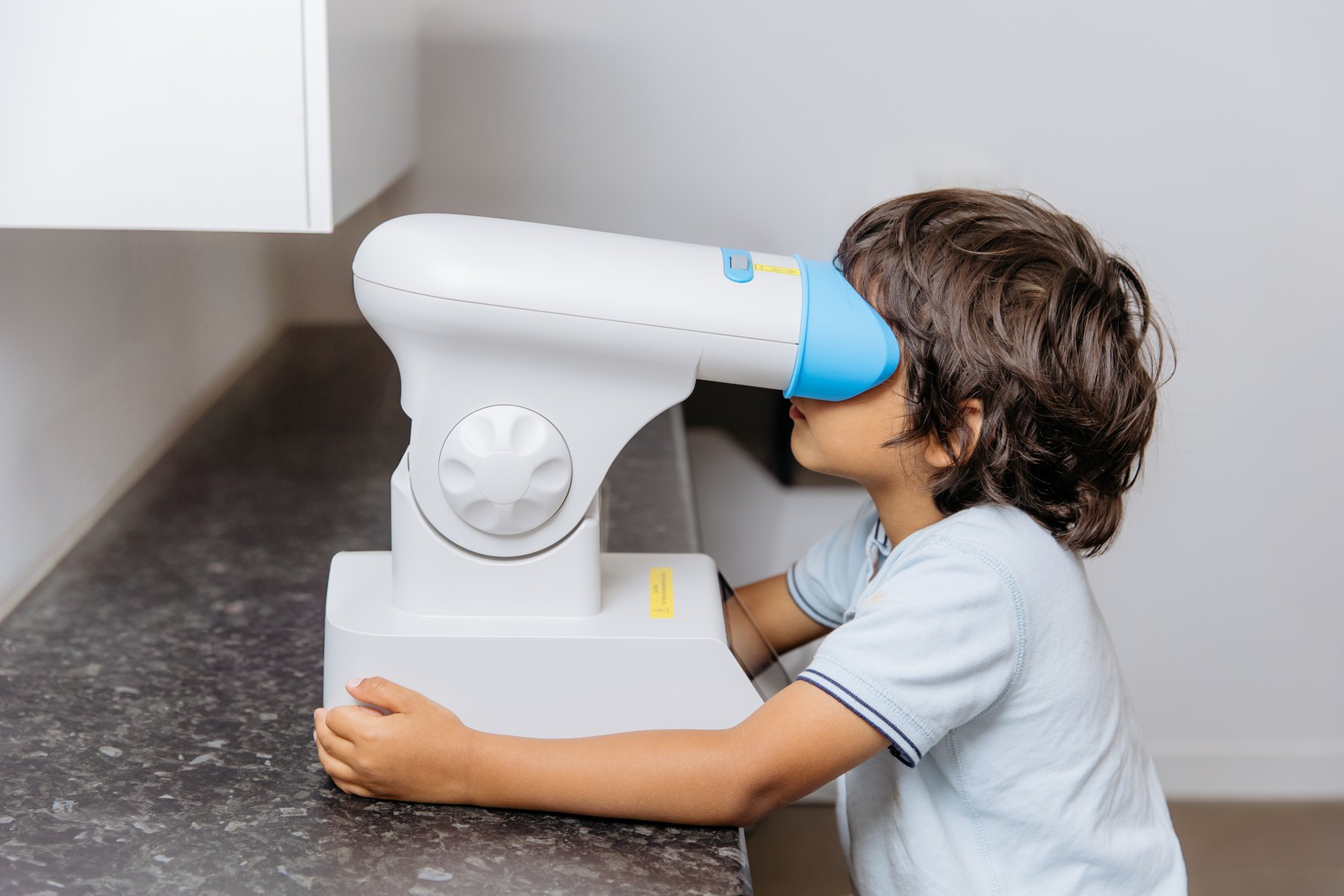
Parents who have read about red-light therapy for childhood myopia often ask the same question: almost all of the research comes from China, so does it apply to children here? A pilot randomised trial from Melbourne, published in Clinical and Experimental Optometry in 2026, is the first attempt to answer that in a multi-ethnic, largely non-Chinese group. It is a useful paper, and a small one.
We have covered the wider body of work in our earlier post on the evidence for red-light therapy in myopia, so this article deals only with what the Australian trial adds.
What the trial did
Between August 2022 and November 2023, optometry clinics in Melbourne enrolled 34 children aged 8 to 13 years with myopia between -0.50 and -5.00 dioptres (D). Children of Chinese heritage were capped at 10% of recruitment. Seventeen children were randomised to repeated red-light laser (RLRL) therapy plus ordinary single-vision spectacles, and 17 to single-vision spectacles alone.
The device emitted red laser light at 650 nm with a stated power of 2.00 ± 0.50 mW. Children looked into it for 3 minutes, twice a day, 5 days a week, with parents supervising. The device logged its own use over the internet; recorded compliance ran at 60 to 80%.
Axial length (the front-to-back length of the eye) and cycloplegic refraction were measured at 1, 3, 6 and 12 months. The primary outcome was change in axial length at 12 months.
What it found
At 12 months the adjusted mean axial length change was -0.03 mm (95% CI, -0.05 to -0.01) in the red-light group and 0.12 mm (95% CI, 0.10 to 0.14) in the spectacle group. The between-group difference was reported as 0.15 mm (P < 0.001). Shortening peaked at 3 months (-0.06 mm), then drifted back towards baseline.
Refraction moved the same way. The adjusted mean change was 0.08 D (95% CI, 0.04 to 0.13) with red light and -0.20 D (95% CI, -0.29 to -0.10) with spectacles alone, a reported between-group difference of 0.29 D.
A 95% confidence interval (CI) is the range within which the true average plausibly lies; narrower is more precise. A P-value is the probability of seeing a difference this large if the treatments were really equal; below 0.05 is the usual threshold for "unlikely to be chance".
Axial length, refraction and an odd visual acuity result
Axial length is the more meaningful measure, and the authors rightly made it the primary outcome. Two cautions apply. First, the control children grew only 0.12 mm in a year, which is slow, so there was little progression to prevent. Second, the authors themselves say it is unclear whether early shortening is a true reversal or a temporary change.
One secondary result sits awkwardly beside the headline. At 12 months, 7 of 14 children in the red-light group (50.0%) had lost two or more lines of unaided vision, compared with 5 of 17 (29.4%) in the spectacle group. All children still corrected to 6/6 or better. With numbers this small it may mean nothing, but the paper does not explain it.
Safety: what was and was not looked for
No severe adverse events were reported, and no child reported glare, flash blindness or afterimages. Three children in the red-light group withdrew after the 3-month visit: two for poor compliance and one because of headache. Nobody withdrew from the spectacle group.
Retinal safety was checked with optical coherence tomography (OCT) scans, reviewed by eye by two ophthalmologists. Retinal thickness was not measured quantitatively, and the authors state that subtle or subclinical microstructural changes cannot be excluded.
This matters because of what has been reported elsewhere, which the authors acknowledge. There is a published case of a 12-year-old with afterimages, reduced vision and disruption of the outer retina on OCT after red-light therapy, which recovered once treatment stopped. A separate study described reduced cone density in treated children, and a laboratory evaluation found that some laser-based devices reached recognised safety limits in less than the recommended 3-minute session. Reports of retinal injury exist, long-term retinal safety is not established, and how these devices should be classified and dosed is still debated. A trial of 17 treated children followed for one year cannot detect an uncommon harm.
Limitations of this evidence
- Small and under-recruited. The plan called for 42 children; recruitment stopped at 34.
- Not sham-controlled. Children, parents and the study coordinator knew who had the device. The measuring optometrists, technicians and statisticians were masked.
- Uneven withdrawals. All three withdrawals came from the treatment group.
- Short follow-up. Twelve months, with no data on what happens after stopping. Rebound is discussed in our post on rebound after myopia treatment.
- Industry involvement. The paper states: "This work was supported by Eyerising International," the maker of the device, and that the funder played no role in design, data collection, analysis, interpretation or writing. Two of the eight authors are listed with Eyerising International affiliations, and one of them was one of the two OCT reviewers. The disclosure statement reads: "Dr. Zhu reported having a patent for CN110237432A. No other conflicting relationship exists." See our post on conflicts of interest in myopia control trials.
- Unmeasured confounders. Outdoor time was not recorded, and there were too few children in any ethnic group to compare them.
- Conclusions run ahead of the data. The discussion describes RLRL as a "first-line treatment". A 34-child pilot against ordinary spectacles does not support that.
- What we did not check. We read the article text; the data tables and supplementary file were not examined.
What we do with this in practice
This trial suggests the short-term effect of red light on axial length is not confined to Chinese children. It does not change the safety picture. Options with longer track records include low-dose atropine, myopia control spectacles, soft contact lenses and orthokeratology.
Which approach suits a particular child depends on age, rate of change, eye length and family circumstances, and is something to discuss with your optometrist. In Hamilton, the optometrist team at Rose Optometry provides myopia control care built around axial length measurement. The team also offers a free Myopia Chat for families who want to talk through the options first. The optometrists at Rose Optometry are Anjali Hira, Emilie Lawson, Jacqueline Rowe, Jagrut Lallu, Jason Shen, Jessica Wood and Stella Wong, and myopia management is part of their clinical practice.
Jagrut Lallu — BOptom (Hons), MSc Specialty Lenses (Hons), FIAOMC. Therapeutic Optometrist & Contact Lens Specialist. Founder, New Zealand Eye Research Centre; Partner, Rose Optometry; WCO Asia-Pacific Myopia Ambassador; International Myopia Institute NZ Ambassador; Clinical Senior Lecturer, Deakin School of Optometry; Honorary Teaching Fellow, University of Auckland.
Reference
- Bulloch G, Qi Z, Aung YY, Fakih Z, Rezazadeh D, Tran D, Zhu Z, Deen N. Efficacy of repeated red-light laser therapy for myopia control in Australian children: a pilot randomised controlled trial. Clin Exp Optom. 2026;109(7):1489-1499. PMID 41951208. https://doi.org/10.1080/08164622.2026.2648328
.svg)

