

Slowing Myopia in Children: How Every Modern Treatment Works — and the Evidence Behind It

Childhood myopia is no longer just a prescription that creeps up each year. It is now widely framed as a disease of eye growth: in 2024 the US National Academies of Sciences, Engineering and Medicine recommended that myopia be formally classified as a disease, and in 2026 the American Medical Association adopted a policy recognising it as a public-health concern and backing coverage for evidence-based myopia treatment. The reason for the shift is simple — the longer an eye grows, the higher the lifetime risk of sight-threatening complications. This article explains how each modern myopia-control option works and what the trial evidence actually shows.
Why axial length is the number that matters
Myopia develops when the eyeball grows too long from front to back (its axial length), so light focuses in front of the retina rather than on it. Every treatment discussed here is aimed at one goal: slowing that axial elongation. It matters because risk scales with the degree of myopia. Bullimore and Brennan (2019) estimated that each additional dioptre of myopia raises the prevalence of myopic maculopathy by roughly 67%, and — encouragingly — that slowing progression by one dioptre may cut the long-term likelihood of maculopathy by about 40%. Tideman and colleagues (2016) found the cumulative risk of visual impairment by age 75 rises steeply with higher myopia. In other words, the millimetres we save in childhood translate into protected vision decades later.
Spectacle lenses that reshape peripheral focus
The largest category of myopia-control options are everyday glasses with specially engineered lenses. All keep a clear central zone for sharp vision while altering the light reaching the peripheral retina — the signal the growing eye appears to respond to.
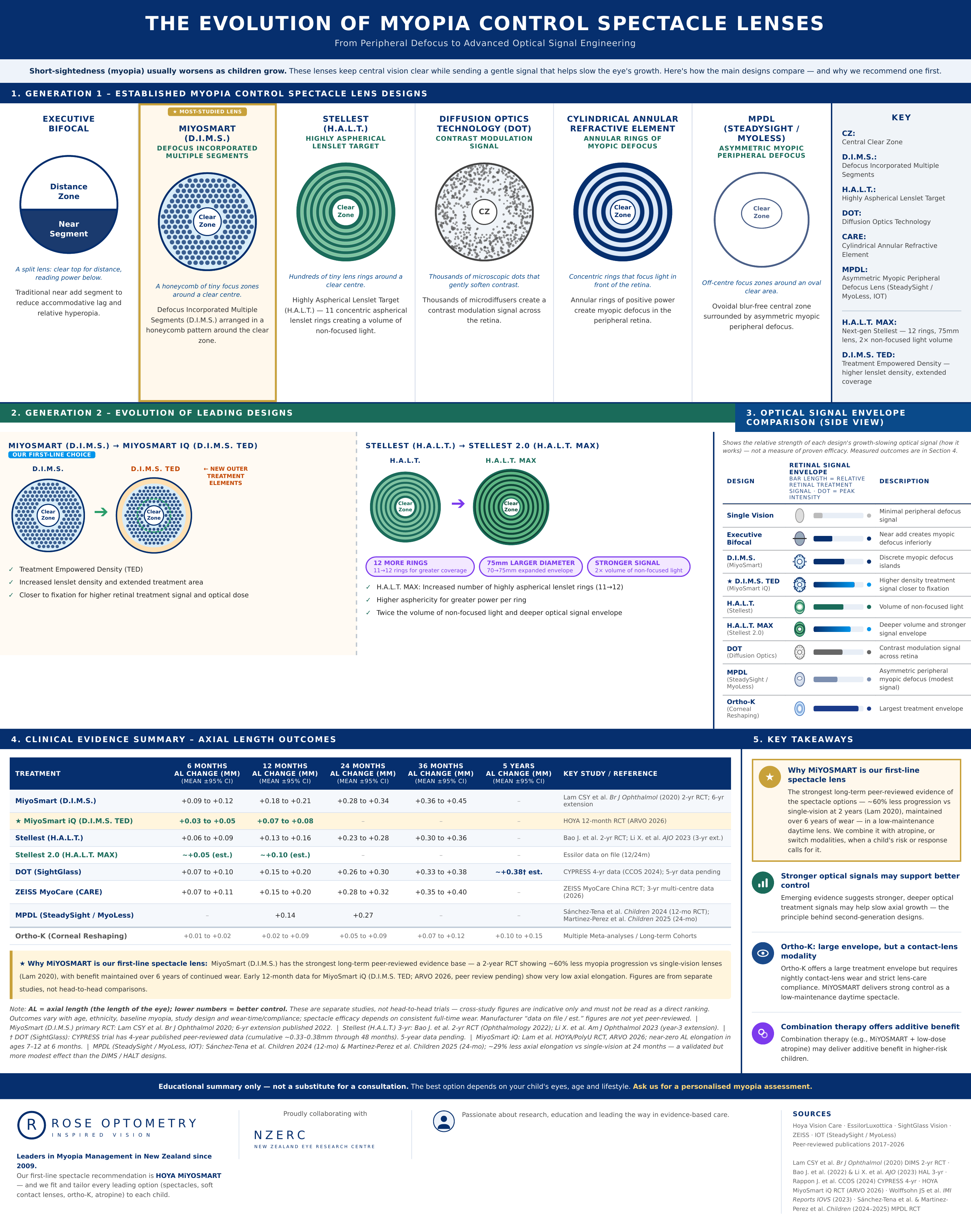
MiyoSmart (D.I.M.S. — Defocus Incorporated Multiple Segments), Hoya. A clear centre is surrounded by a honeycomb of hundreds of tiny defocus segments. In the landmark 2-year double-masked randomised controlled trial (Lam et al., British Journal of Ophthalmology, 2020), MiyoSmart slowed myopia progression by about 59% and axial elongation by about 60% versus standard single-vision lenses, and a 6-year follow-up (2023) showed the effect was sustained with no rebound. It has the deepest long-term peer-reviewed evidence base of the spectacle options.
Stellest (H.A.L.T. — Highly Aspherical Lenslet Target), Essilor. Eleven concentric rings of more than a thousand aspherical lenslets create a volume of myopic defocus in front of the peripheral retina. The 2-year RCT (Bao et al., 2022) reported roughly 51% less axial elongation overall, rising to about 67% in children who wore the lenses at least 12 hours a day — a reminder that wear time drives results.
ZEISS MyoCare (C.A.R.E. — cylindrical annular refractive elements). Alternating concentric rings combine correction with myopic defocus. It is the newest of the spectacle designs; a 2-year RCT of the underlying CARE technology (2025) reported about 46% less axial elongation, though the longer-term evidence base is still maturing.
SightGlass Vision DOT (Diffusion Optics Technology). Thousands of microscopic light-scattering dots gently lower peripheral retinal contrast, based on the theory that chronically high contrast drives elongation. In the CYPRESS trial (Rappon et al., 2023) the treatment lens reduced axial growth by about 50% in the first year, with the effect concentrated early.
SteadySight (MPDL — asymmetric myopic peripheral defocus lens), IOT. Marketed internationally as MyoLess and available in New Zealand as SteadySight, this lens has an oval clear centre surrounded by asymmetric peripheral plus power. Two-year results (Martinez-Perez et al., Children, 2025) showed about 29% less axial elongation than single-vision lenses — a genuine but more modest effect than the DIMS and HALT designs, and from a smaller single-centre cohort.
Contact-lens and pharmacological options
Orthokeratology (ortho-K). Rigid lenses worn overnight temporarily reshape the cornea, giving clear unaided daytime vision and creating peripheral myopic defocus. Randomised data (ROMIO, Cho & Cheung, 2012) and meta-analyses show roughly 45–52% less axial elongation over two years. The main safety consideration is a small risk of microbial keratitis, so hygiene and monitoring are essential.
Soft dual-focus contact lenses (MiSight 1 day, CooperVision). A daily-disposable soft lens with concentric treatment zones. The 3-year RCT (Chamberlain et al., 2019) showed about 52% less axial elongation and 59% less refractive progression; 6- and 7-year data show a sustained effect and no rebound after stopping. Daily disposables keep infection risk low and suit children ready to handle lenses.
Soft myopia-control lenses with RingBoost optics (Acuvue Abiliti 1-Day, Johnson & Johnson). A newer daily-disposable option that uses non-coaxial “RingBoost” optics rather than the concentric dual-focus design. Manufacturer clinical data report about 0.31 mm less axial elongation over three years, with roughly 55% of children showing no clinically meaningful progression, and over 95% achieving 6/6 vision — the company positions it as around twice as effective as a dual-focus lens, though independent long-term data are still accruing. It broadens the daily soft-lens choice for children suited to contact lenses.
Low-dose atropine. Nightly low-concentration atropine eye drops slow axial elongation through a receptor pathway largely independent of pupil dilation. The LAMP trial (Yam et al., 2019) found 0.05% the most effective of the low concentrations tested, with 0.025% and 0.01% offering smaller effects. In New Zealand, low-dose atropine (Eikance) — a prescription medicine — became the first atropine eye drop approved by Medsafe specifically to slow the progression of myopia, in December 2023.
Repeated low-level red-light therapy (RLRL). A desktop device delivers brief daily doses of 650 nm red light to the retina. The key RCT (Jiang et al., Ophthalmology, 2022) reported not just slowed growth but slight axial shortening at 12 months. The signal is striking, but follow-up is short, a rebound appears after stopping, and long-term retinal safety is not yet established — so it is best treated as a newer, closely monitored option rather than a settled therapy.
How the options compare
| Option | Key trial | Axial-length slowing vs control |
|---|---|---|
| MiyoSmart (DIMS) | Lam 2020, 2-yr RCT | ~60% |
| Stellest (HALT) | Bao 2022, 2-yr RCT | ~51% (up to ~67% if worn ≥12 h/day) |
| ZEISS MyoCare (CARE) | Chen/Zhu 2025, 2-yr | ~46% |
| SightGlass DOT | CYPRESS, Rappon 2023 | ~50% (year 1) |
| SteadySight / MyoLess (MPDL) | Martinez-Perez 2025, 2-yr | ~29% |
| Ortho-K | ROMIO 2012 / meta-analyses | ~45–52% |
| MiSight 1 day | Chamberlain 2019, 3-yr | ~52% |
| Acuvue Abiliti 1-Day | J&J RingBoost, 3-yr data | ~0.31 mm less over 3 yr (mfr data) |
| Atropine 0.05% | LAMP, Yam 2019 | Most effective low concentration |
| Red-light therapy (RLRL) | Jiang 2022, 1-yr | Large short-term effect; long-term safety unproven |
An honest read of the evidence
These figures come from separate trials in different populations, not head-to-head comparisons, so the percentages should be read as indicative rather than as a strict ranking. Effect sizes depend heavily on age, starting prescription and — for every option — consistent wear or use. The strongest, longest peer-reviewed datasets sit with MiyoSmart, MiSight and ortho-K; ZEISS MyoCare, Acuvue Abiliti and the newer red-light devices have promising but shorter or largely manufacturer-reported evidence. Increasingly, the most important questions are about combination therapy (for example, an optical treatment plus atropine) and about which child benefits most from which approach — precisely the questions that require well-designed, locally relevant research.
Myopia research at the New Zealand Eye Research Centre
Childhood myopia is a global problem that will be solved with global evidence — and New Zealand has a part to play in generating it. The New Zealand Eye Research Centre (NZERC) is committed to contributing rigorous, measurement-driven research on myopia control: standardised axial-length monitoring, real-world outcomes across the full range of treatments, and the head-to-head and combination-therapy questions the field still needs answered. Research organisations, device and lens manufacturers, and sponsors evaluating a New Zealand site for myopia studies are invited to partner with NZERC. Separately, families and clinicians seeking assessment and treatment can reach NZERC's affiliated clinical practice, Rose Optometry in Hamilton.
References
Lam CSY, Tang WC, Tse DY, et al. Defocus Incorporated Multiple Segments (DIMS) spectacle lenses slow myopia progression: a 2-year randomised clinical trial. British Journal of Ophthalmology. 2020;104(3):363–368.
Lam CSY, Tang WC, Zhang HY, et al. Long-term myopia control effect and safety in children wearing DIMS spectacle lenses for 6 years. Scientific Reports. 2023;13:5475.
Bao J, Huang Y, Li X, et al. Spectacle lenses with aspherical lenslets for myopia control: a 2-year randomised clinical trial. JAMA Ophthalmology. 2022;140(5):472–478.
Chen X, Zhu Y, et al. Cylindrical annular refractive element (C.A.R.E.) spectacle lenses for myopia control: a 2-year randomised trial. American Journal of Ophthalmology. 2025.
Rappon J, Chung C, Young G, et al. Diffusion Optics Technology spectacle lenses for myopia control (CYPRESS): 12-month results. British Journal of Ophthalmology. 2023.
Sánchez-Tena MÁ, Cleva JM, Villa-Collar C, et al. Effectiveness of a spectacle lens with asymmetric myopic peripheral defocus: 12-month results. Children. 2024;11(2):177.
Martinez-Perez C, Sánchez-Tena MÁ, Cleva JM, et al. Efficacy of asymmetric myopic peripheral defocus lenses (MPDL; marketed as MyoLess / SteadySight): 24-month RCT results. Children. 2025;12(2):191.
Cho P, Cheung SW. Retardation of Myopia in Orthokeratology (ROMIO) study: a 2-year randomised clinical trial. Investigative Ophthalmology & Visual Science. 2012;53(11):7077–7085.
Chamberlain P, Peixoto-de-Matos SC, Logan NS, et al. A 3-year randomised clinical trial of MiSight lenses for myopia control. Optometry and Vision Science. 2019;96(8):556–567.
Johnson & Johnson Vision. ACUVUE Abiliti 1-Day (RingBoost technology) myopia-control clinical data; 3-year results, 2026.
Yam JC, Jiang Y, Tang SM, et al. Low-Concentration Atropine for Myopia Progression (LAMP) study. Ophthalmology. 2019;126(1):113–124.
Jiang Y, Zhu Z, Tan X, et al. Effect of repeated low-level red-light therapy for myopia control in children: a randomised controlled trial. Ophthalmology. 2022;129(5):509–519.
Bullimore MA, Brennan NA. Myopia control: why each dioptre matters. Optometry and Vision Science. 2019;96(6):463–465.
Tideman JWL, Snabel MCC, Tedja MS, et al. Association of axial length with risk of uncorrectable visual impairment. JAMA Ophthalmology. 2016;134(12):1355–1363.
National Academies of Sciences, Engineering, and Medicine. Myopia: Causes, Prevention, and Treatment of an Increasingly Common Disease. Washington, DC: The National Academies Press; 2024.
.svg)

