Glasses or overnight lenses? What 'non-inferior' does and doesn't mean
Jagrut Lallu — BOptom (Hons), MSc Specialty Lenses (Hons), FIAOMC. Therapeutic Optometrist & Contact Lens Specialist. Founder, New Zealand Eye Research Centre; Partner, Rose Optometry; WCO Asia-Pacific Myopia Ambassador; International Myopia Institute NZ Ambassador; Clinical Senior Lecturer, Deakin School of Optometry; Honorary Teaching Fellow, University of Auckland.
Parents weighing up myopia control often ask whether spectacles are as good as overnight orthokeratology (ortho-k) lenses. A Danish randomised trial published in BMC Ophthalmology in 2026 concluded that defocus incorporated multiple segment (DIMS, sold as MiYOSMART) spectacle lenses were "non-inferior" to ortho-k over 18 months. That word has a precise statistical meaning, and it is easy to read more into it than the trial supports.
How the trial was run
This was a single-centre, open-label, non-inferiority randomised trial at Lillebaelt Hospital in Vejle, Denmark. Ninety children aged 6 to 12 years were randomised 1:1 to DIMS spectacles (n = 45) or ortho-k (n = 45) using an aspheric reverse-geometry lens (Dreamlite, CooperVision). Ortho-k was the reference treatment.
The primary outcome was axial length (AL) elongation at 18 months, measured without cycloplegia. Families and outcome assessors knew each child's treatment; only interpretation of the primary analysis was blinded. Funding came from academic and foundation sources and the authors declared no competing interests. The ortho-k lenses were donated by a distributor; the paper does not say who supplied the DIMS lenses.
What "non-inferior" means
A non-inferiority trial does not ask whether a new treatment is better, or identical. It asks whether it is not unacceptably worse than an established treatment, by more than a margin set in advance. Here the margin was 0.13 mm of extra axial growth. DIMS would count as non-inferior if the upper limit of the 95% confidence interval for the difference (DIMS minus ortho-k) was no more than 0.13 mm in both the intention-to-treat (ITT) and per-protocol analyses.
A 95% confidence interval (CI) is the range of true differences reasonably compatible with the data. In a non-inferiority trial the decision rests on where that range ends compared with the margin, not on the P value. A P value above 0.05 only means no difference was detected; it does not show two treatments are alike.
The between-group results
In the adjusted ITT analysis of all 90 children, axial length grew by 0.22 mm with DIMS and 0.26 mm with ortho-k. The difference was −0.05 mm (95% CI, −0.13 to 0.04; P = 0.319). In the per-protocol analysis of 71 children, both groups grew by 0.22 mm, a difference of −0.01 mm (95% CI, −0.10 to 0.09; P = 0.885).
Because the upper limits (0.04 mm and 0.09 mm) sat below 0.13 mm, DIMS met the definition of non-inferiority. Because neither interval sat entirely below zero, DIMS was not shown to be superior. Overall eye length (axial length plus choroidal thickness) gave a similar picture, with an adjusted ITT difference of −0.04 mm (95% CI, −0.12 to 0.04).
What it does not mean
Non-inferior is not "equal". The per-protocol interval is compatible with DIMS being up to 0.09 mm worse or 0.10 mm better than ortho-k.
The margin itself deserves scrutiny. It was derived from the refraction-to-axial-length relationship equivalent to 0.25 D in Danish female children, not as a fraction of ortho-k's known benefit over no treatment. For context, the paper cites ortho-k effects versus control of 0.24 mm at 18 months and 0.26 mm at 2 years, and does not say what share of that benefit the 0.13 mm margin preserves.
There was also no untreated or single-vision group, so the trial cannot show that either treatment beat no treatment in these children. The conclusion assumes ortho-k worked here as well as in earlier trials.
The corneal-thickness adjustment
Ortho-k reshapes and thins the central cornea, which makes measured axial length slightly shorter and would make ortho-k look more effective than it is. The investigators therefore added the change in central corneal thickness back to each ortho-k measurement. This makes ortho-k elongation slightly larger, which tilts the comparison towards DIMS relative to an uncorrected analysis. It is a reasonable correction, but its size is not reported.
Dropout: a result in its own right
A third of the ortho-k group dropped out (15/45, 33.33%) compared with 4/45 (8.89%) with DIMS (P = 0.004), mainly because ortho-k could not be successfully started. Dropouts were more likely to have two myopic parents. They were offered an 18-month examination, so most still contributed ITT data, though some may have switched to other treatments.
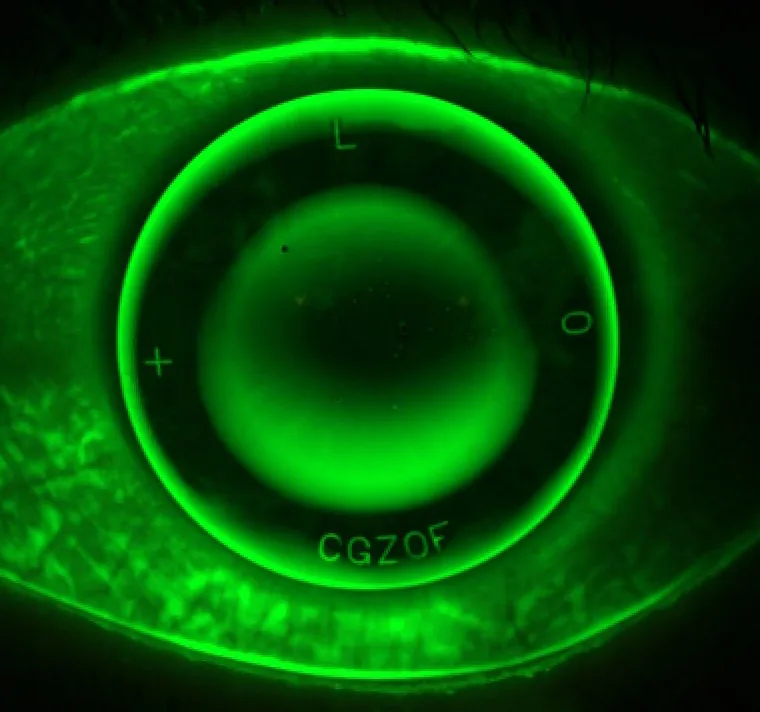
In non-inferiority trials, ITT analysis can blur real differences, so consistent per-protocol results matter; here they agreed. The dropout gap is also a practical finding: ortho-k needs a successful start, careful handling and regular reviews, as our orthokeratology lens care guide explains.
Safety and age
One adverse event was recorded, in the ortho-k group: grade 2 corneal staining, treated with preventive chloramphenicol drops. No microbial keratitis was reported. A post hoc analysis suggested less elongation with DIMS than ortho-k after 10 years of age; this is hypothesis-generating only.
Limitations of this evidence
- Open label, single centre, small. Ninety children at one hospital, with unmasked participants and assessors.
- Short follow-up. Eighteen months; the authors note two years would better match current recommendations.
- No untreated control, so non-inferiority relies on ortho-k performing as it has elsewhere.
- Baseline imbalance. The DIMS group had more myopia (−3.18 vs −2.74 D); adjusted and unadjusted results were similar.
- Self-reported adherence, with missing reports assumed to mean full wear.
- Limited outcomes. No refraction progression, follow-up visual acuity or fast-progressor data were reported, and ethnicity and outdoor time were not accounted for.
- Generalisability. Children unsuitable for ortho-k were excluded, and the findings apply to one ortho-k design.
What this means for families in Hamilton
Over 18 months and within a pre-set margin, DIMS spectacles may slow axial growth on average about as well as one ortho-k design, with far fewer children dropping out in this trial. It does not show that one option suits every child. Our reviews of the two-year DIMS versus 0.01% atropine trial and an ortho-k trial with a smaller treatment zone add context.
Choosing between spectacles and overnight lenses depends on age, prescription, corneal suitability and family routine, and should follow a professional assessment. Our optometrists, including Jagrut Lallu and Jacqueline Rowe, provide myopia control at Rose Optometry in Hamilton. To talk through the evidence first, book a free Myopia Chat with Jagrut.
References
- Andersen LC, et al. Defocus incorporated multiple segment spectacle lenses versus orthokeratology lenses for myopia control: a non-inferiority randomised clinical trial. BMC Ophthalmology. 2026;26(1):488. PMID: 42595991. DOI: 10.1186/s12886-026-05144-6